By Chris Tomsic, Client Services Specialist & Workplace Inclusion Administrator, LINC
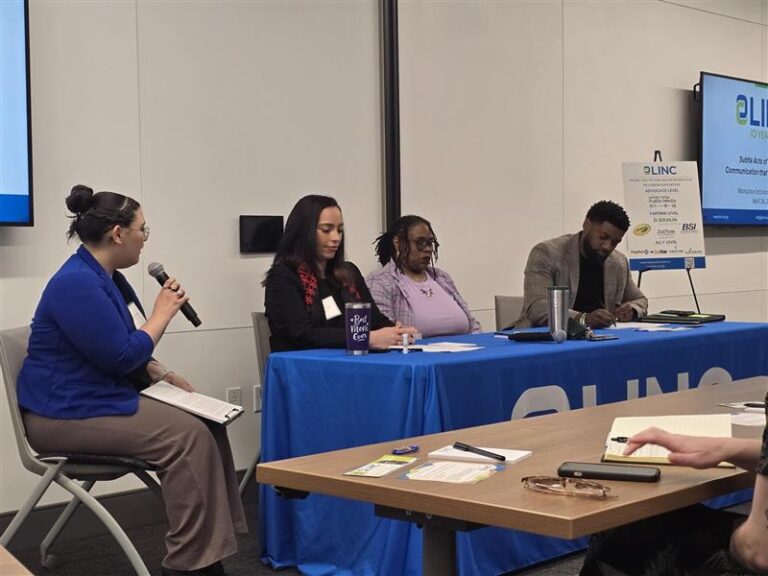
This month, LINC convened the latest Roundtable in its 2026 series with a candid and timely conversation on exclusion that often goes unnoticed – not because it is rare, but because it is subtle. Subtle Acts of Exclusion: Communication that Builds Belonging, brought together leaders and practitioners to examine how everyday communication, management practices, and organizational norms can unintentionally erode trust, safety, and belonging in the workplace. This conversation was inspired by and rooted in the framework for addressing these moments, established by Dr. Tiffany Jana and Michael Baran’s book, “Subtle Acts of Exclusion: How to Understand, Identify, and Stop Microaggressions.”
Rather than focusing on overt discrimination or policy failures alone, this session centered on the quiet moments that shape employee experiences: a meeting scheduled when frontline staff cannot attend; a communication rollout that assumes access or flexibility not everyone has; a new manager repeating poor leadership behaviors they themselves endured. These small acts accumulate, panelists emphasized, shaping culture far more than mission statements ever could.
The discussion opened with an important reframing: subtle acts of exclusion are rarely intentional. Most stem from assumptions – about availability, commitment, communication styles, or what “professional” looks like. Yet intention does not negate impact. As one speaker noted, when exclusion shows up repeatedly in how decisions are made and information is shared, it becomes a structural problem, not a personal one.
Panelists grounded the conversation in data that underscored the urgency of the issue. Only 30% of people in management or people‑leader roles have received formal management training, leaving the remaining 70% navigating leadership by trial and error. At the same time, 50% of employees report leaving jobs because of bad managers, revealing a direct connection between poorly supported leadership and turnover. New managers, lacking training and feedback, often replicate the behaviors modeled above them, reinforcing why culture change cannot happen only from the middle. It requires both top‑down commitment and bottom‑up accountability.
“This isn’t a people problem,” one panelist summarized. “It’s a financial emergency.” When talented employees disengage or leave due to misalignment, misunderstanding, or lack of psychological safety, organizations absorb the cost through lost productivity, turnover, and damaged morale.
Much of the conversation focused on how assumptions drive exclusion. Panelists shared that the more diverse and interconnected a person’s community is, the more likely they are to notice, and interrupt, their own biases. Homogeneous environments, by contrast, tend to normalize narrow perspectives. In the workplace, this can show up in decisions that unintentionally privilege certain roles or life circumstances, particularly those of salaried or office‑based employees.
Concrete examples resonated deeply with attendees:
- Meetings scheduled outside the hours most accessible to frontline or shift‑based staff
- Parental leave policies excluding spouses
- Organizational changes announced through channels not accessible to all employees
- Leadership decisions made without input from those most affected
These practices may seem neutral, but their cumulative effect communicates who belongs and who does not.
From there, the conversation turned toward accountability. Rather than positioning harm as a reason for punishment, panelists emphasized modeling accountability as a leadership skill. When exclusion occurs, leaders are encouraged to pause, seek understanding, and acknowledge discomfort rather than rushing to defensiveness. Naming harm, taking ownership, and repairing through action, not just words, is essential to rebuilding trust.
Equally important is redefining what growth looks like. Moving forward does not require someone to be “in trouble.” It requires investment: management training, emotional intelligence, and social awareness. Leaders who can recognize the emotional and relational impact of their decisions are better equipped to build inclusive teams and to interrupt exclusion before it hardens into culture.
A portion of the roundtable addressed power dynamics, particularly for individuals with limited formal authority. For those navigating exclusion upward, panelists shared practical strategies:
- Use “nudges” rather than confrontations: “How do we usually handle situations like this?”
- Build a case rooted in impact and outcomes, not blame
- Learn to manage down and manage up with clarity and consistency
- Model inclusive behavior rather than mirroring harmful leadership styles
- Avoid forcing closure when harm has occurred – many employees want immediate action, not premature resolution
Healing, panelists noted, is not linear. People who experience exclusion, even subtly, need space to process and reconnect. Attendees were encouraged to create healing spaces for themselves, whether through trusted colleagues, community networks, nature, or through affinity groups. Tuning into what one needs for reconnection was framed as an act of self-preservation, not withdrawal.
This led naturally into a discussion of psychophysiological safety; the body’s response to stress, exclusion, and vigilance in the workplace. When employees feel they must constantly scan for risk, exclusion becomes embodied, not just emotional. Panelists highlighted the role organizations can play in countering this by intentionally fostering environments where people can find their “tribes.”
Business resource groups, employee networks, and cross functional communities were lifted as tangible examples of how organizations can help employees build connection and belonging. When supported authentically – with time, resources, and leadership sponsorship – these groups can mitigate isolation and create feedback loops that strengthen organizational decision‑making.
As the session closed, a clear message emerged: communication is never neutral. Every meeting invite, policy announcement, and leadership response sends a signal. Building belonging requires slowing down, listening deeply, and designing systems that reflect the full reality of the workforce, not just the most visible parts of it.
To translate the conversation into action, several guiding practices surfaced:
For Organizations:
- Invest in formal management training as a core business strategy, not a perk
- Review communication norms and meeting practices for accessibility and inclusion
- Normalize accountability as growth, not punishment
- Support employee resource groups and community building initiatives
- Embed emotional and social intelligence into leadership expectations
For Managers and Leaders:
- Pause before responding when discomfort arises
- Seek understanding rather than intent based defenses
- Name harm, take ownership, and repair through visible action
- Model inclusive behaviors consistently, especially under pressure
For Individuals:
- Find or build spaces where you can reconnect and be affirmed
- Advocate where possible using curiosity-based dialogue
- Protect your wellbeing by tuning into your own signals of safety and stress
The roundtable reaffirmed that belonging is not built through grand gestures alone. It is created in the everyday moments that define how people experience work. By naming subtle acts of exclusion and committing to more intentional communication, organizations can move closer to cultures where everyone has the opportunity to fully contribute and thrive.
Additional Resources: